How to cut your wedding guest list without falling out with anyone
The short answer. Agree the number before you discuss names: your catering budget divided by the cost per guest, capped by your venue. Then sort everyone into tiers, cut whole groups by rules that apply to everybody, and use separate events, so people can be invited to the celebration without being invited to everything.
Start with a number, not a list
Arguments about the guest list are almost always arguments about names. Take the names out of it first. Work out the number you can afford and fit, and agree it with both families before anybody's cousin is discussed.
| Your figures | Example |
|---|---|
| Money for food and drink | £18,000 |
| Cost per guest, from your caterer | £90 |
| Number you can afford | £18,000 ÷ £90 = 200 |
| Venue capacity | 250 |
| Your number | The smaller of the two: 200 |
If your list is 320 and your number is 200, the job is to remove 120 places. Seeing it as one number to hit, rather than 120 people to disappoint, is what keeps the conversation calm.
Sort everyone into tiers
Write down everyone, then put each person in one of three tiers.
- A: the wedding wouldn't feel right without them. Immediate family, closest friends, the people who will make a speech.
- B: you would genuinely love them there. Wider family, good friends, people you see every month.
- C: you would invite them if numbers were unlimited. Colleagues, old friends you've lost touch with, parents' acquaintances.
Count the A list. If it already exceeds your number, the conversation is about the number, not the list. If it doesn't, the B list fills the rest and the C list waits.
Cut by rules, not by people
Cutting a person feels personal. Cutting a group by a rule that applies to everyone is easy to explain and hard to argue with. Pick the rules that fit your family and apply them evenly.
- The two-year rule: if you haven't spoken or met in two years, they're off.
- Plus-ones for couples only: married, engaged or living together. Single guests come alone.
- Children: none, family only, or under a certain age. One rule for everyone.
- Colleagues: only those you see outside work.
- Parents' friends: a fixed number per set of parents, and they choose.
- The dinner test: would you buy this person dinner for £90? If not, they're a C.
Give each family a number of places and let them fill it. It moves the hardest decisions to the people who know those relationships best, and nobody can say you chose against them.
Invite people to fewer events instead of none
A multi-day wedding has a gentler tool than cutting someone out. Invite them to the event where numbers are easy, and not to the one where every seat is counted.
The reception may be the expensive meal, while the traditional wedding, the church service or an evening party costs less per head. A colleague can come to the church and the evening party and still feel invited. In many families, being at the ceremony matters more than being at the dinner.
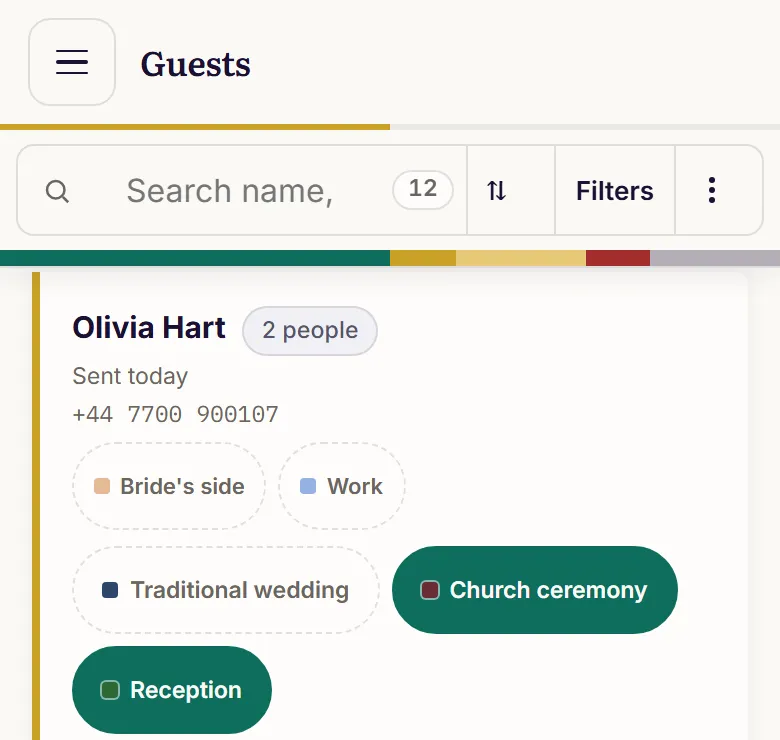
This only works if each guest sees only their own events and replies to each separately. One invitation listing everything, with one RSVP, makes it impossible. On Our Guest List you tick the events each guest is invited to, and their invitation shows only those, with a reply for each. See how to manage a multi-day guest list.
What to say to people who aren't invited
Most people understand numbers. Say it once, simply, and don't apologise for days.
We're keeping the wedding small, so we've had to limit numbers to close family. We'd love to celebrate with you properly afterwards.
Our venue only holds 120, so we've had to make some very hard choices. It isn't a reflection of how much you mean to us.
We're inviting colleagues to the evening party rather than the day itself, and we'd love you to come to that.
Keeping the B list in reserve
Some invited guests will say no. If you plan to invite more people as those replies come in, send the first round early and set a reply date that leaves time for a second. Invite the second round at least six weeks before the day, so it doesn't feel last-minute.
With Our Guest List, every guest has their own link, so you can see the declines arrive event by event, and add and send to the next guests whenever you are ready. The free plan covers 50 guests and two events, so you can start free and move to a package, from £65 as a one-off payment, for a bigger list.
Questions people ask
- How do I cut my wedding guest list without offending people?
- Agree a number first, then cut whole groups by rules that apply to everyone, such as no plus-ones for single guests or no colleagues. People rarely take a rule personally. Where you can, invite them to part of the celebration rather than none of it.
- How many wedding guests usually decline?
- It varies with distance and timing. A wedding far from most guests, or on a weekday, sees more declines than a local Saturday. Rather than guess, set an early reply date and read your own replies before inviting your B list.
- Is it OK to have a child-free wedding?
- Yes. Say so clearly on the invitation and apply it to everyone, family included, or name the exceptions, such as page boys and flower girls, so nobody is left guessing.
- Do I have to invite people who invited me to their wedding?
- No. Your number and your relationships today decide it. If you were invited years ago and are no longer close, a kind word is enough.
Last updated 29 October 2026