Igbo traditional wedding guest list: planning the Igba Nkwu
The short answer. An Igbo traditional wedding, the Igba Nkwu or wine carrying, is traditionally held by the bride's family, at their home, and both families invite guests of their own. Agree a number for each side, collect the families' lists early with phone numbers, merge them into one list, and invite each household by name with a headcount, so the hall, the food and the door all match the people who come.
What is Igba Nkwu?
Igba Nkwu means "wine carrying". At the heart of it, in many families, the bride's father hands her a cup of palm wine, she carries it through the crowd to find the groom and offers it to him, and once he drinks, the couple are celebrated by both families and their guests. It usually follows the knocking (iku aka), when the groom's family first visits, and the meetings where the families agree the marriage list and the bride price. Customs differ from one town and family to another, so ask your elders how yours does it.
In Nigeria it is often held at the bride's family home. In the UK it is more often a hall, sometimes on the same weekend as the church wedding, and sometimes months apart.
Who is invited to an Igbo traditional wedding?
| Group | Who usually invites them | What to agree |
|---|---|---|
| The bride's family and kinsmen (umunna) | Her parents and elders | How many places they need, and who speaks for the family |
| The groom's family and kinsmen | His parents and elders | How many are travelling with them, and when they arrive |
| Family friends, church and town associations | Both sets of parents | A number per side, so neither list runs away |
| The couple's own friends | The couple | Whether they are also invited to the church and reception |
The Igba Nkwu is often bigger than the church wedding, because it belongs to both families as much as to the couple. Decide early whether your own friends come to both, and keep one list with a tick for each event. The multi-day guest list guide shows the layout.
How do you stop the guest list growing?
- Agree a number for each side before anyone writes a name, and write it down.
- Ask each family for a list with phone numbers, by a date, in one shared format.
- Merge the lists into one, and mark whose guest each person is.
- Invite by household, with a number. An invitation for "the Okafor family, 4" is easier to hold to than one for "the Okafors".
- Agree what happens at the door when someone arrives who isn't on the list, before the day rather than on it.
If the merged list is bigger than the hall, cutting your guest list has a method that doesn't single anybody out.
Elders often invite people by word of mouth. Ask them gently to send the names to whoever is keeping the list, so those guests get a proper invitation and a place.
What should the Igba Nkwu invitation say?
Many Igba Nkwu invitations come from the bride's parents, or from both families. Change the names and titles to your own:
Mr and Mrs Emeka Nwosu warmly invite you to the Igba Nkwu of their daughter, Adaeze, to Kunle, son of Mr and Mrs Babatunde Ajayi.
The Nwosu and Ajayi families invite you to celebrate the traditional marriage of Adaeze and Kunle. Colours of the day: coral and gold.
Nnọọ! Adaeze and Kunle, with their families, invite you to the Igba Nkwu on Saturday 4 September.
More wording for every Nigerian ceremony is in Nigerian wedding invitation wording, and the messages for selling fabric in the colours are in aso-ebi announcement messages.
If the Igba Nkwu is in Nigeria and the wedding is in the UK
Many UK couples hold the traditional wedding in the bride's hometown and the church and reception here. Then the two events have different guests almost by definition: family at home for one, friends and family in the UK for the other. Give each event its own guest list, put the Igba Nkwu's time in Nigerian time, and send guests from the UK the travel details early. Inviting wedding guests from abroad covers visas, time zones and phone numbers.
How to do it with Our Guest List
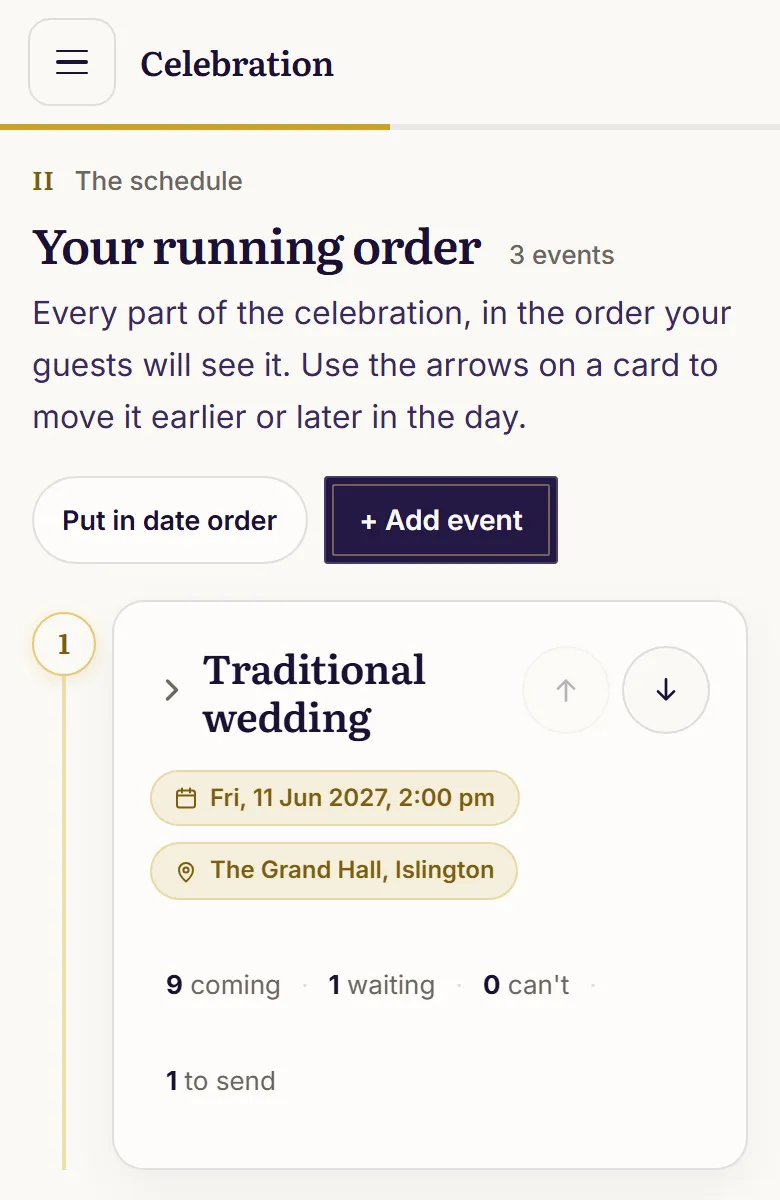
- Add the events. Open the Celebration step and press + Add event for the Igba Nkwu, and the church and reception if they follow. Put each event's colours in Dress code. For a ceremony in Nigeria, set the event's time zone so guests see the time as Lagos time.
- Add both families' guests. Paste the merged list, or type them. Put each household on one invitation and set how many people it is for.
- Choose their events. Open a guest and press Choose their events. A guest invited only to the Igba Nkwu sees only the Igba Nkwu.
- Send. Each household gets its own message on WhatsApp or iMessage from your phone, and replies for each event with a headcount. Numbers in Nigeria go in with +234 in front.
- Check guests in. Turn on door check-in in the Celebration step, and send the door link to whoever the families trust on the door. They need no account.
The free plan covers 50 guests and two events. A large Igba Nkwu needs a package, from £65: Tailored, a one-off £65, covers 400 guests and every event, and Bespoke covers any number. See the wedding page for a sample invitation, or the Nigerian wedding guest list guide for the whole wedding.
Questions people ask
- Who hosts an Igbo traditional wedding?
- In many families the bride's family hosts the Igba Nkwu, traditionally at their home, with the groom's family arriving as honoured guests. In the UK it is often held in a hall and the costs may be shared. Ask your families how they intend to do it.
- Is the Igba Nkwu bigger than the church wedding?
- Often, because it belongs to both families and their friends, associations and church members as much as to the couple. Keep one list with a tick per event so each event gets its own headcount.
- How do you invite guests to an Igbo traditional wedding?
- Many families still invite some guests in person or by phone, especially elders, and send a written or digital invitation to everyone else. Inviting each household by name, with the number of people the invitation is for, keeps the count accurate.
- What do guests wear to an Igba Nkwu?
- Often traditional dress in the colours of the day, such as george wrappers for the women and isiagu for the men, sometimes in aso-ebi fabric the families have chosen. Guests without traditional clothes are usually welcome in smart clothes in those colours.
Last updated 30 October 2026