Planning a Nigerian wedding in the UK: the events and the guest list
The short answer. Plan a Nigerian wedding in the UK as one guest list with several events: the introduction, the traditional wedding, the church service and the reception. Collect both families' lists early and merge them, tick which events each guest is invited to, and get a separate yes or no and headcount for each event, because each has its own venue, caterer and door.
What are the events of a Nigerian wedding?
Every family does it differently, and Yoruba, Igbo, Edo, Hausa and other weddings each have their own ceremonies. For a UK couple, the shape is often something like this, spread over a few months or squeezed into one weekend:
| Event | Who is usually there | What the guest list needs |
|---|---|---|
| Introduction (Igbo: iku aka, the knocking) | Close family of both sides, and the elders who speak for them | Often no invitation at all: the families arrange it |
| Traditional wedding (Yoruba engagement, Igbo Igba Nkwu) | Both families and their friends, often the biggest crowd | The families' guests merged with yours, and the colours of the day |
| Church or registry (the white wedding) | A smaller list if the church is small | A count that fits the pews |
| Reception | Everyone at the church, and often more | The caterer's number, dietary needs and the door |
| Thanksgiving service or after-party | Varies: family, or friends only | Its own reply, so it doesn't inflate the reception count |
Muslim couples, including many Yoruba and most Hausa families, hold a nikah in place of the church service, often with a walima or reception after: see nikah and walima invitations. Some couples hold the traditional wedding in Nigeria and the church and reception in the UK, or the other way round, which changes who can travel to what. If guests are flying in, see inviting wedding guests from abroad. For an Igbo traditional wedding in particular, see planning the Igba Nkwu guest list.
How do you merge the families' guest lists?
In many Nigerian families the parents, aunties and uncles invite guests of their own, especially to the traditional wedding. Those lists are usually the biggest surprise in the planning, so ask for them early, in one format, and merge them into yours before anything is sent.
- Agree a number per side for each event, before anyone starts writing names.
- Ask each family for a list with phone numbers, and say which events each name is for.
- Merge into one list of people, one row each, with a column per event and a column for whose guest they are.
- Look for duplicates. The same cousin often appears on both mothers' lists, once as "Bisi" and once as "Mrs Adebisi Cole".
- Put households together, so a family of five is one invitation with five places rather than five invitations.
The multi-day guest list guide shows the layout, and cutting your guest list helps when the merged list is bigger than the hall.
Who gets invited to the traditional wedding and who to the church?
Agree the tiers with both families before anybody is told anything. A common pattern:
- Family-led events (introduction, traditional wedding): often the families' guests as much as yours.
- The church: everyone you would be happy to see in the pews, limited by the building.
- The reception: the biggest list in many UK weddings, limited by the hall and the caterer.
- Friends-only extras (an after-party): kept off the elders' invitations entirely.
Each guest should be told only about their own events. That is easier with an invitation per household listing just those events than with one picture showing the whole weekend. The words for each invitation are in Nigerian wedding invitation wording.
What goes out when?
| When | What to send |
|---|---|
| 6 to 12 months before | A save the date to everyone, especially guests who need flights or a visa |
| 4 to 6 months before | The aso-ebi announcement, so there is time to buy fabric and see a tailor |
| 8 to 12 weeks before | The invitations, each guest's own events and a reply-by date |
| 4 to 6 weeks before | Your reply-by date |
| 2 or 3 days after the reply-by date | A reminder to anyone who hasn't replied, and an update about anything that has changed |
| 2 to 3 weeks before | Final numbers to the caterer and venue |
| Within a few weeks after | Thank yous, naming what each guest gave |
The messages for the aso-ebi step are in aso-ebi announcement messages, and the general timeline in when to send wedding invitations.
Aso-ebi often goes out before the invitations. That is fine, but make sure it doesn't promise a seat at an event the guest isn't invited to.
Keeping the door to the people you invited
Big Nigerian weddings are generous by nature, which is partly why uninvited guests turn up. A line saying "strictly by invitation" only works if somebody at the door can check it, so give the door a list per event: a name, how many people that invitation is for, and whether it covers this event. Our Guest List's door check-in does this for you, with a pass on each guest's invitation (below). More in how to stop gatecrashers at a wedding.
Thank yous after the day
Many guests at a Nigerian wedding give cash or spray money on the dance floor, and some give gifts. Note who gave what as it comes in, while you still remember, and thank each guest by name afterwards. You don't need to say an amount; "thank you for your generous gift" is enough. Wedding thank-you messages has wording for money as well as presents.
How to do it with Our Guest List
Our Guest List was built for weddings like this: several events, households, and a separate reply for each.
- Add each event. Open the Celebration step and press + Add event for the traditional wedding, the church and the reception. Give each its date, venue and, in Dress code, its colours.
- Add everyone's guests. Paste the merged list, bring people in from your phone's contacts, or type them. Put a whole family on one invitation and set how many people it is for.
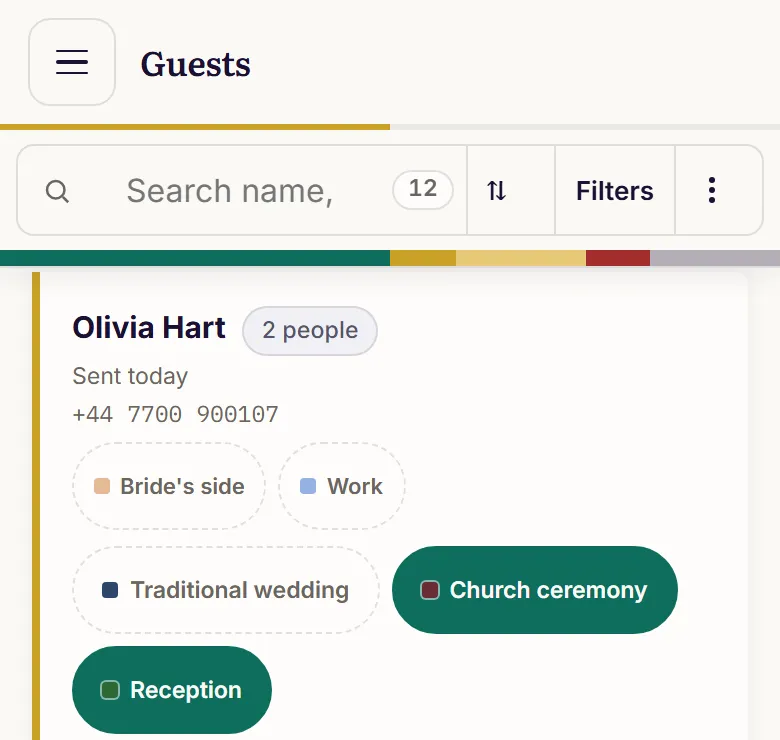
- Choose their events. Open a guest and press Choose their events. Their invitation shows only the events you tick.
- Send. Each household gets its own message on WhatsApp or iMessage from your phone, and answers each event on its own link.
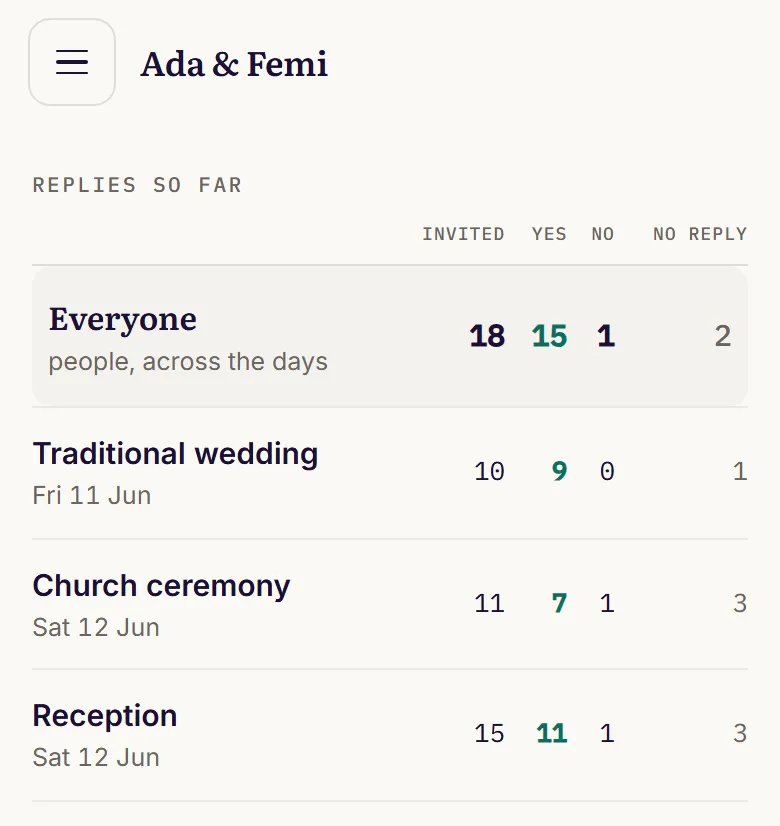
- Read the numbers. Home shows the totals for every event, and Export guest list gives your caterer each event's headcount and the dietary notes.
- Check guests in. Turn on door check-in in the Celebration step. Every guest who says yes gets a pass on their invitation, and your door team gets a link that needs no account.
- Say thank you. In the Thank yous step, go through your guests one at a time and type what each one gave, and their card thanks them for it.
The free plan covers 50 guests and two events, enough to try it with one side of the family. Bigger weddings need a package, from £65: Tailored, a one-off £65, covers 400 guests and every event, and Bespoke covers any number. Questions are answered on the FAQ, and you can see a sample invitation on the wedding page.
Questions people ask
- Do the traditional wedding and the white wedding need separate guest lists?
- They can share one list of people with a tick per event. The traditional wedding is often larger and family-led, the church smaller. One list stops anyone being counted twice, and each event still gets its own headcount.
- How many guests come to a Nigerian wedding?
- It varies widely, from small family affairs to several hundred guests. The traditional wedding is often the largest event. Count each event separately, because the number at the church and the number at the reception are rarely the same.
- How do you stop the parents' guest lists getting out of hand?
- Agree a number per side for each event before anyone writes names, ask for the lists early with phone numbers, and merge them into one list with a column per event. A fixed number per side is easier to hold to than a list that grows by message.
- How do you thank guests for cash gifts at a Nigerian wedding?
- Thank each guest by name and mention their generosity without naming an amount. Keeping a note of who gave what as gifts arrive makes it possible to thank people properly weeks later.
Last updated 30 October 2026